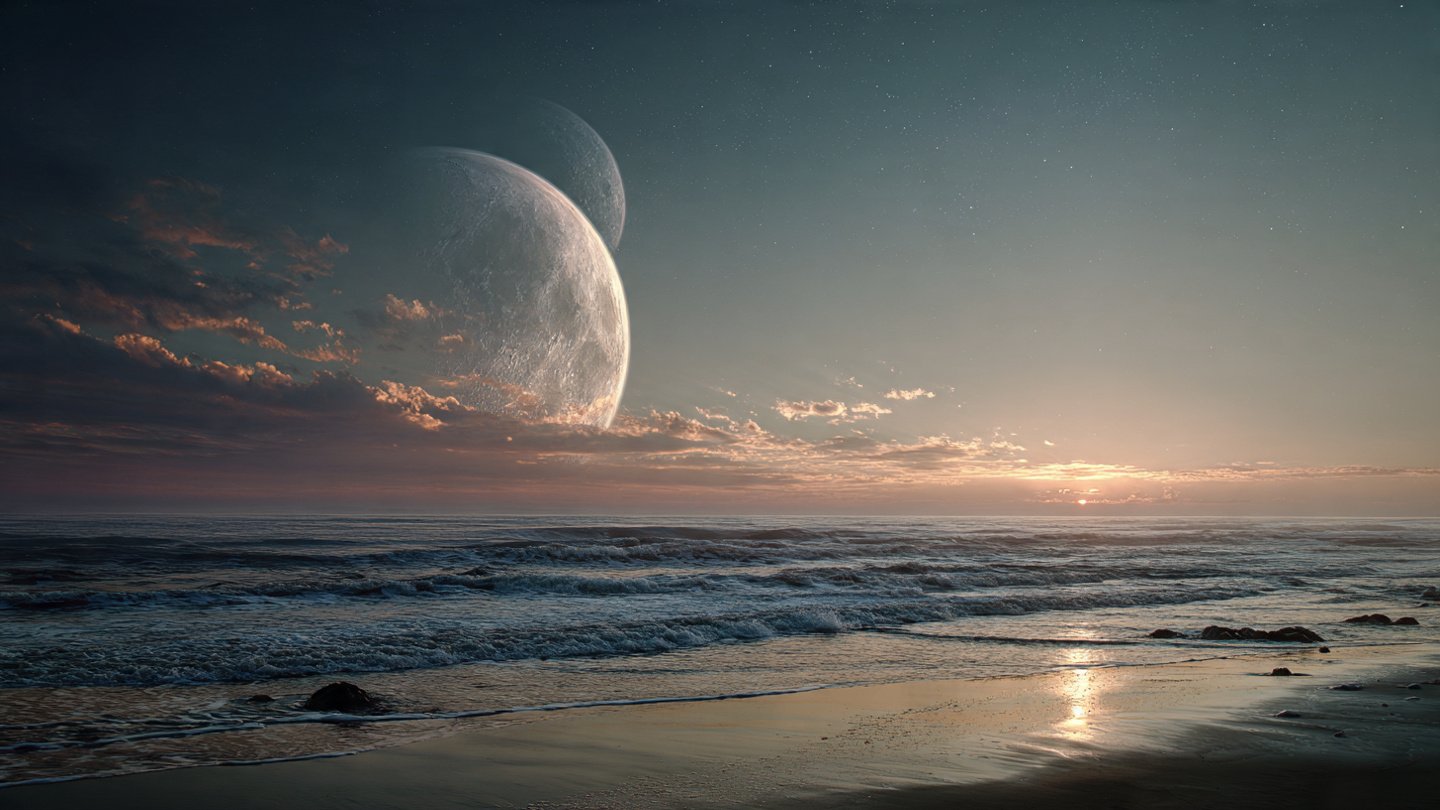
For as long as humans have observed the night sky, the Moon has held a special place in our imagination. From guiding ancient calendars to inspiring myths and folklore, it has been a constant companion orbiting our planet. Yet, the Moon is not as fixed in the sky as it appears. In fact, it is slowly drifting away from Earth at an astonishingly precise rate, a process that has profound implications for the length of our days, the behavior of tides, and the delicate balance of life on our planet. Understanding this phenomenon requires a look into the mechanics of the Earth-Moon relationship, the science of tides, and how even subtle changes in celestial distances affect life on Earth.
The Moon’s Gradual Drift
The Moon is currently moving away from Earth at an average rate of approximately 3.8 centimeters per year, a figure confirmed by lunar laser ranging experiments. Scientists first obtained this data during the Apollo missions, which left retroreflectors on the Moon’s surface. By bouncing laser beams off these mirrors and timing the return, researchers can measure the distance between Earth and the Moon with millimeter precision.
Although 3.8 centimeters per year may sound small, over millions of years, this distance becomes significant. Around 600 million years ago, for example, a day on Earth lasted just 21.9 hours, compared to our current 24-hour day. The increasing distance between Earth and the Moon is closely tied to this change in the length of our days.
Tidal Friction: The Mechanism Behind the Drift
The key driver of the Moon’s slow departure is tidal friction, a phenomenon that occurs due to the gravitational interaction between Earth and the Moon. As the Moon orbits, it exerts a gravitational pull on Earth’s oceans, creating tidal bulges—essentially, high tides. Because Earth rotates faster than the Moon orbits, these bulges are slightly ahead of the Moon’s position in its orbit.

This misalignment produces a gravitational tug on the Moon, transferring rotational energy from Earth to lunar orbital energy. As a result:
- Earth’s Rotation Slows Down: The transfer of energy causes our planet’s rotation to gradually decelerate, lengthening the day by about 1.7 milliseconds per century. While imperceptible on a human scale, over millions of years, this adds up, making days noticeably longer.
- The Moon Moves Away: The energy transferred to the Moon increases its orbital distance. As the Moon drifts farther from Earth, its orbital period slows, meaning it takes longer to complete a single orbit.
This energy exchange illustrates a delicate cosmic balance. Without tidal friction, our days would remain shorter, and the Moon might have been much closer—or collided with Earth billions of years ago.
Impact on Tides
Tides, which are critical for marine ecosystems and coastal environments, are directly influenced by the Moon’s gravitational pull. High tides occur where the gravitational pull is strongest, and low tides occur where it is weakest. As the Moon moves farther away:
- Tidal Force Weakens: The gravitational influence of the Moon diminishes slightly, leading to less extreme high and low tides.
- Longer Tidal Cycles: Because the Moon takes longer to orbit Earth, the timing of tides shifts gradually. High and low tides may occur later over centuries, subtly affecting marine life and coastal processes.
- Coastal Implications: Many species, from crabs to coastal plants, rely on tidal rhythms for reproduction, feeding, and migration. While the changes are slow, they can influence evolutionary adaptations over geological timescales.
Even minor alterations in tidal patterns can ripple through ecosystems, affecting everything from plankton blooms to fish migrations, demonstrating how tightly interconnected life on Earth is with lunar mechanics.

Historical Evidence of a Changing Moon
Scientists have been able to track the Moon’s influence on Earth through geological and fossil records. Ancient tidal rhythmites—sedimentary layers formed by tides—show how the number of days per year has changed over hundreds of millions of years.
- Proterozoic Era (~600 million years ago): Fossil evidence indicates that there were roughly 400 days in a year, reflecting shorter days of around 21.9 hours.
- Devonian Period (~400 million years ago): Days lengthened to roughly 22.5 hours.
- Today: A day lasts 24 hours, and a year consists of approximately 365.25 days.
These records highlight the Moon’s gradual outward drift and its impact on Earth’s rotation. Over the next billions of years, scientists predict that days could extend to about 47 current Earth days once the Earth-Moon system reaches tidal locking. This is a theoretical endpoint where Earth would always show the same face to the Moon, similar to how the Moon currently shows only one face to Earth.
Effects on Life and the Environment
The Moon’s drift has subtle but long-term implications for life on Earth:
- Biological Rhythms: Many organisms, including marine species, birds, and nocturnal animals, rely on lunar cycles for reproductive and migratory behaviors. A slowly changing Moon could influence these cycles over evolutionary timescales.
- Climate and Ocean Currents: Tides drive ocean mixing, which distributes heat and nutrients globally. Changes in tidal energy may alter ocean circulation patterns, potentially affecting climate systems.
- Human Society: Ancient humans depended on tides for fishing and agriculture in coastal areas. Today, while technology reduces direct dependence, tidal energy is increasingly harnessed for renewable power, making Moon-driven tides economically significant.
Understanding these changes underscores the importance of the Moon not just as a celestial companion but as a fundamental regulator of life on Earth.

The Moon’s Future Journey
Scientists estimate that the Moon will continue drifting away for billions of years, eventually reaching a point where tidal locking occurs. By that time, Earth’s rotation will have slowed considerably, and days will be far longer. However, this process is extremely gradual, allowing life to adapt over millennia.
Interestingly, the Sun will undergo its own evolution during this period. In roughly 5 billion years, the Sun will expand into a red giant, engulfing the inner planets and likely altering or ending the Earth-Moon system as we know it. Thus, the Moon’s slow drift is part of a much larger cosmic timeline.
Current Implications and Scientific Importance
While the drift is imperceptible on a day-to-day scale, monitoring the Moon’s movement provides crucial scientific insights:
- Lunar Laser Ranging: By measuring the distance to the Moon with extreme precision, scientists test theories of gravity and planetary motion.
- Earth-Moon Dynamics: Understanding the energy transfer helps researchers model Earth’s rotational history and predict future changes.
- Astrophysical Research: Studying the Moon’s drift informs our understanding of other planetary systems, particularly exoplanets with satellites, helping scientists anticipate tidal effects on potential habitable worlds.
In short, the Moon’s outward journey is not only a curiosity—it’s a window into fundamental physics, geology, and biology.

Fascination and Cultural Impact
Beyond science, the Moon’s drift also has cultural significance. Its phases, tides, and positions have guided human activity for millennia. Ancient calendars, navigation methods, and rituals were based on lunar cycles. Modern fascination with space exploration, lunar bases, and the potential for mining further fuels interest in understanding how the Moon interacts with Earth.
Knowing that the Moon is slowly moving away adds a poetic dimension to our celestial companion. What appears fixed and eternal is subtly changing, reminding us of the dynamic universe we inhabit.
Conclusion
The Moon’s gradual drift away from Earth is a slow but profound process with far-reaching consequences. Driven by tidal friction, it lengthens our days, shifts tidal patterns, and influences life on Earth in ways we are only beginning to fully understand. While the changes are imperceptible in a human lifetime, over millions of years, they have shaped the planet’s environment, ecosystems, and even human history.
From geological evidence to laser measurements, scientists continue to unravel the story of the Moon’s outward journey. This knowledge not only informs our understanding of the past but also allows us to anticipate the distant future of our planet. The Moon may seem like a constant fixture in our sky, but it is, in fact, a dynamic partner in the dance of celestial mechanics, quietly shaping the rhythm of life on Earth with each passing year.

As the Moon drifts further into space, it reminds us of the subtle yet powerful forces that govern our world—a celestial clockwork that links oceans, days, and life itself to the silent motion of a distant rock in the night sky.