Across the vast northern reaches of China, where windblown sand and dust storms once defined the horizon, an ambitious and sprawling effort is underway: the creation of a “Great Green Wall” — a colossal ecological shield made of tens of billions of trees. This initiative, officially known as the Three‑North Shelterbelt Program, is one of the most audacious environmental engineering projects ever attempted. Its goal is simple yet monumental: slow, halt and even reverse the advance of deserts such as the Gobi and Taklamakan by turning arid expanses of land into stable, vegetated landscapes. But as with all grand undertakings, the story is both hopeful and complex, marked by notable achievements, significant challenges, and deep ecological trade‑offs.
An Epic Plan to Fight Desertification
The Great Green Wall began in 1978 in response to growing concerns about desertification — the process by which fertile land becomes increasingly dry, degraded, and lifeless due to drought, deforestation, overgrazing, and climate change. China’s northern frontier, home to vast sand seas and dust prone regions, has been a source of sandstorms that can stretch for thousands of kilometers, affecting air quality and agriculture far beyond the desert margins.
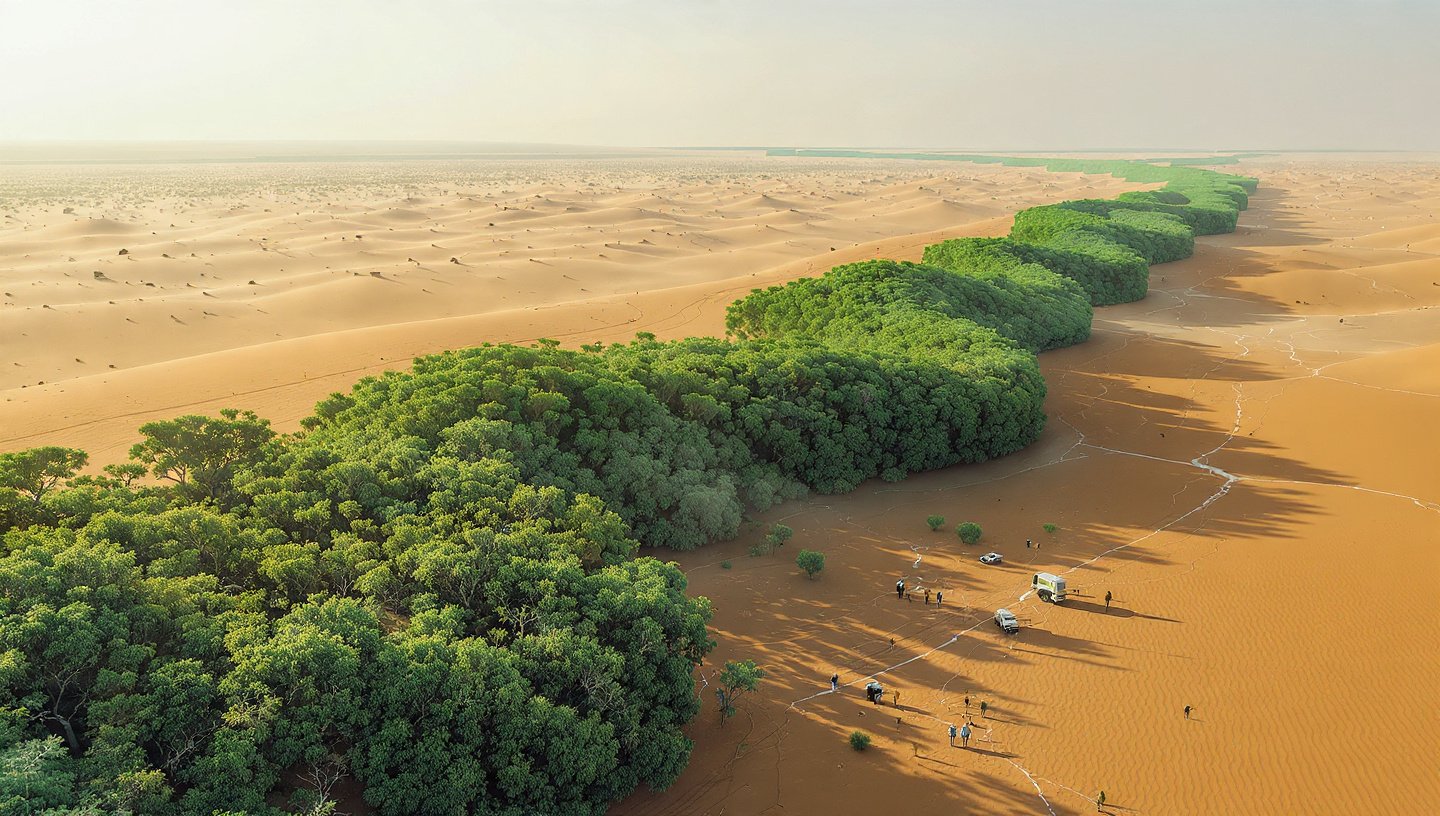
The core idea behind the project is deceptively simple: plant trees, shrubs, and vegetation in massive shelterbelts extending across China’s north, northeast, and northwest. These green belts act as windbreaks, reducing the force of sand‑laden winds, stabilizing dunes, anchoring soils, and creating microclimates that can support further vegetation growth.
Stretching thousands of kilometers — with plans to reach around 4,500 kilometers (about 2,800 miles) in length and cover vast swathes of desert‑prone regions by 2050 — this project is expected to become the world’s largest human‑made forest belt. When complete, it will span an area comparable to 42% of China’s landmass and comprise tens of billions of trees, shrubs, and grasses.

Roots in History, Growth Over Decades
China’s war against desertification didn’t start with fancy technology or satellite tracking. In its early years, local communities, soldiers, and volunteers worked with basic tools, digging pits, sowing seedlings, and constructing straw grids to trap drifting sand. Over time, planting strategies evolved — incorporating lessons about water availability, plant selection, and ecological balance.
The program has helped China’s forest coverage increase from roughly 10% of the country’s territory in 1949 to about 25% today, a dramatic shift in the country’s ecological fabric. A major milestone was reported in late 2024: a 3,000‑kilometer green belt around the Taklamakan Desert was completed, signifying decades of ongoing commitment to the effort.
But planting trees is only the first step. Scientists and forestry officials have increasingly turned to innovation to boost survival rates and efficiency. In parts of the northern deserts, drones and intelligent planting machines now deliver seedlings across sandy expanses, insert them into the ground, water their roots, cover them with soil and compact the surrounding earth — all with minimal human labor. These technologies have boosted efficiency, reduced costs, and helped plant resilient species such as Salix mongolia (a drought‑tolerant willow).
Measuring Success — And Limits
From satellite imagery to local observations, parts of northern China are visibly greener than they were decades ago. Dust storms, once regular seasonal visitors to cities like Beijing, have seen declines in frequency and intensity, a change experts and officials attribute partly to the shelterbelts’ role in stabilizing soils.

China’s massive planting efforts have also inspired similar campaigns elsewhere — most notably Africa’s Great Green Wall, a project spanning thousands of kilometers across the southern edge of the Sahara. Experts view these efforts as part of a global response to dryland degradation.
However, the effectiveness of planting trees as a standalone solution to desertification is debated. Trees struggle to survive in the extremely arid conditions of many desert margins, and mortality rates can be high without continuous care and irrigation. Many early failures were due to fast‑growth species planted without consideration for local water scarcity — trees that looked impressive when planted but failed to thrive.
Ecologists also point out that a monoculture forest — large swaths of a single type of tree — does not support the biodiversity of natural forests and can place strain on local water resources. Even when trees do grow, they may consume more water than the landscape can naturally supply, further drying soils and lowering water tables.
Ecological Trade‑offs and Water Challenges
While the Great Green Wall has increased vegetation cover and helped stabilize sandy soils in many areas, it has also had complex effects on water distribution. A recent scientific study shows that China’s efforts to plant tens of billions of trees — including the shelterbelt program alongside other initiatives like Grain for Green and Natural Forest Protection — have altered the country’s hydrology.

Trees increase evapotranspiration — water moving from land and vegetation into the atmosphere — which can change where rain falls and how much water remains available locally. In China’s eastern monsoon and northwestern arid regions, this has translated into reduced water availability — even as some other areas, like the Tibetan Plateau, see increases in rainfall.
This redistribution of water presents a dilemma: efforts to revegetate deserts may inadvertently stress water‑scarce regions that are already vulnerable, especially where millions of people, agriculture, and ecosystems depend on limited freshwater supplies. These findings highlight that large‑scale afforestation must consider water resource planning and ecological balance, not just area planted.
Socio‑Economic Impacts
Beyond the science and satellite images, the Great Green Wall affects communities on the ground. In many desert margins, planting campaigns have created jobs, driven innovation, and provided opportunities for local residents. People once living in harsh environments have seen more vegetation, less drifting sand, and — in rare early harvests — new agricultural or horticultural opportunities.
Yet these changes also come with social trade‑offs. In regions like Inner Mongolia, traditional nomadic lifestyles have been constrained by grazing bans and land use changes that prioritize tree plantations over historic pastoral practices. Many herders report that fenced plots and restricted movement undermine patterns of life that have existed for centuries.

What Lies Ahead
China’s Great Green Wall is far from finished. The project officially runs through 2050, and there is still much to learn about how best to balance tree planting, water availability, ecosystem health, and human needs.
Future strategies emphasize planting smarter, not just planting more — selecting native and drought‑adapted species, using advanced technologies for planting and monitoring, and integrating sustainable land management practices that work with local ecosystems rather than imposing external solutions.
Researchers and planners also recognize that combating desertification requires more than a green belt. Tackling the root causes — such as climate change, soil degradation, unsustainable farming, and water scarcity — is essential for long‑term resilience. This means aligning afforestation with broader environmental policies and socio‑economic development goals that prioritize ecological health, water security, and the wellbeing of rural communities.
Conclusion: A Bold Experiment with Global Lessons
China’s Great Green Wall stands as one of the most remarkable ecological endeavours of the modern era. Tens of billions of trees, billions of dollars, and generations of effort have gone into trying to slow the advance of deserts that have shaped landscapes and livelihoods for centuries. The project’s progress demonstrates both human ingenuity and the limits of technical solutions in the face of complex natural systems.

While parts of northern China have visibly greened and dust storms have diminished, the deeper lessons of this project extend far beyond tree counts or boundary lines. The battle against desertification is rooted not just in planting trees, but in understanding water cycles, soil health, climate dynamics, and sustainable livelihoods. As China refines its approach and the world watches, the Great Green Wall offers both inspiration and caution — a reminder that environmental problems require holistic, adaptive, and community‑centered solutions.
In this era of global climate challenges, projects like the Great Green Wall — bold in vision and ambitious in scale — help shape how nations think about restoration, resilience, and coexistence with nature.